
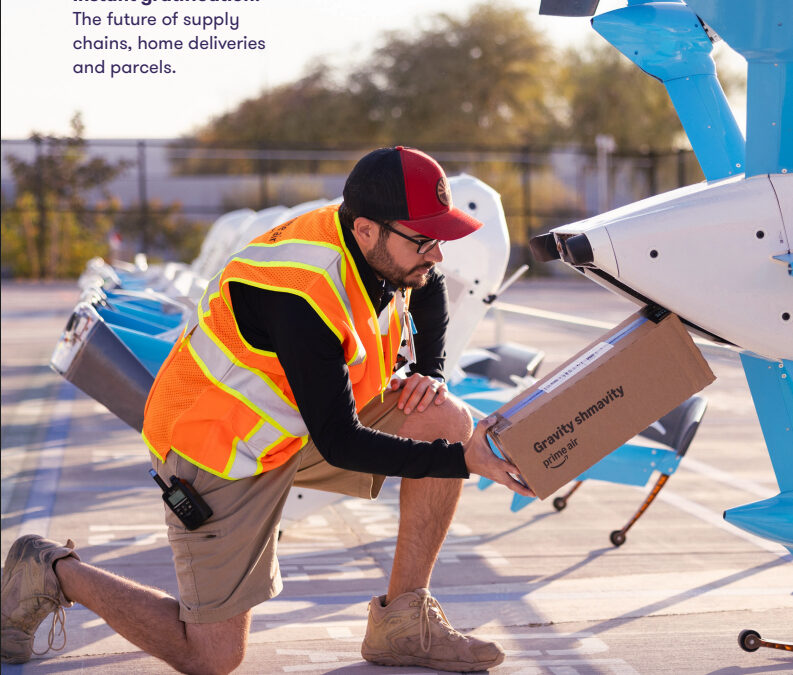
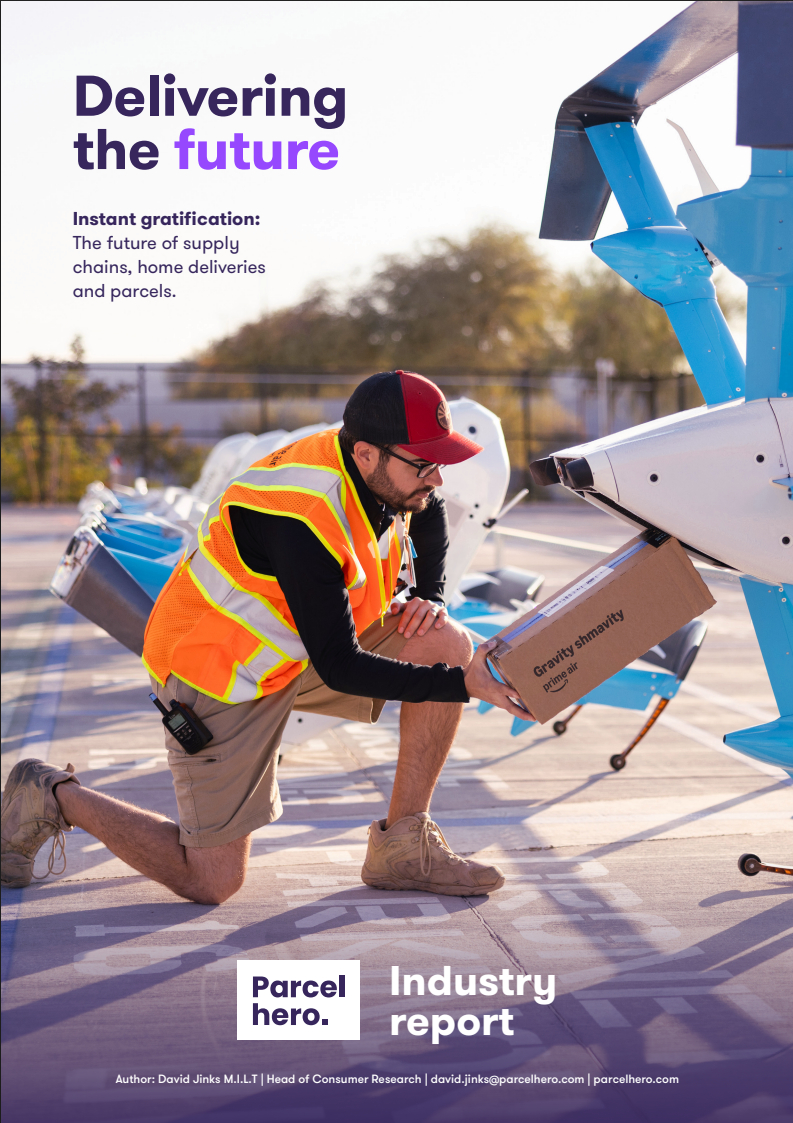
Parcelhero has launched a major new industry report, ‘Delivering the Future: Instant gratification – The Future of Supply Chains, Home Deliveries and Parcels’, examining how quickly the gap between ordering something and receiving it is closing, and what that means for consumers, retailers and even house prices.
The author, David Jinks, Parcelhero’s head of consumer research, said: ‘Our report charts two horizons. Looking to 2030, it finds that the one hour delivery slot, once a novelty, has become the baseline against which every new service is judged, with companies such as Gopuff already targeting 15 minute urban grocery delivery.
‘The report examines the rapid growth of pavement delivery robots, the expansion of Amazon’s Prime Air drone network in both the UK and US, and the arrival of autonomous trucks running fixed motorway routes between regional hubs. It reveals that the value of the global autonomous last mile delivery market, currently around $28 billion, looks set to rocket to more than $228 billion by 2035.
‘Looking further ahead, to 2060 and beyond, the report draws on long range scenario work from organisations including the United Nations Industrial Development Organisation and the UK Government Office for Science, exploring possibilities ranging from underground automated freight networks and floating warehouses to a world where home ‘3D fabbing’ replaces much of today’s finished goods delivery altogether.
‘At the furthest edge of the report’s scope, it even considers the theoretical – and currently very distant – possibility of quantum teleportation, following experiments that have already moved a particle’s state reliably across three metres in a laboratory.
‘The report also raises a striking near-term prediction: that delivery access itself could start to influence UK house prices, with well served postcodes commanding a premium and properties under busy commercial drone routes potentially seeing the opposite effect – echoing the way broadband speed and mobile signal are already quietly factored into property decisions today.
‘Instant gratification has been promised for years, but what has changed is that the infrastructure is finally catching up with the ambition. Fifteen minute grocery drops, pavement robots and driverless trucks on fixed motorway routes aren’t science fiction anymore – they are already operating, and by 2030 they will simply be how a lot of deliveries work.
‘Further out, the honest answer is that nobody can predict a single future with certainty, which is exactly why we have drawn on the scenario work being done by organisations such as the UN and the UK government. What we can say is that the direction of travel is unmistakable: stock, and increasingly manufacturing itself, keeps moving closer to the customer’s front door, and the definition of what counts as ‘in stock’ keeps loosening. Even the far fetched idea of teleportation isn’t dismissed outright by the physicists working on it – though nobody is expecting a parcel to beam onto a doorstep any time soon.’
The ‘Delivering the Future’ report is available now at https://www.parcelhero.com/en-gb/resources/ebooks/delivering-the-future