
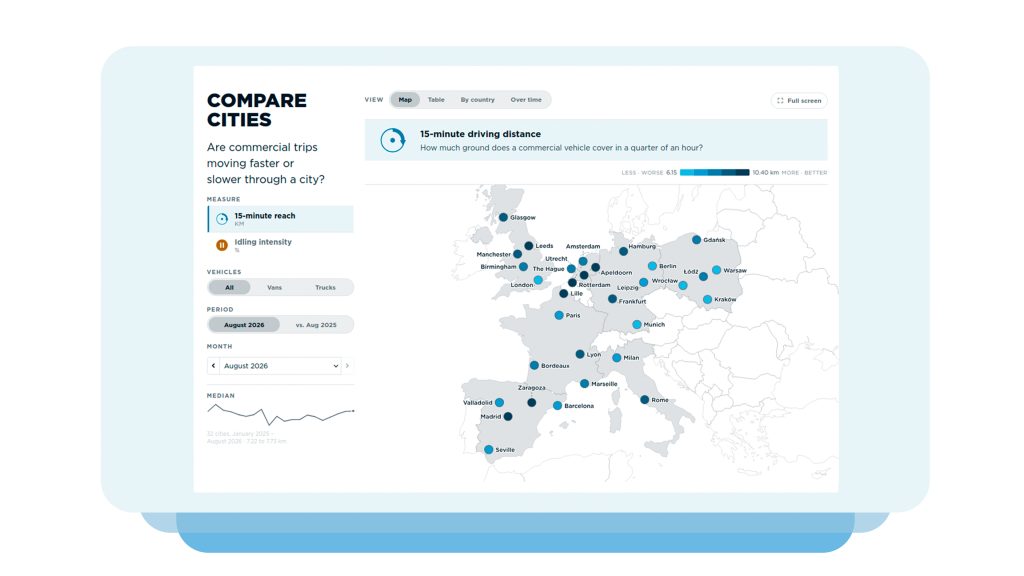
Webfleet, Bridgestone’s advanced fleet management solution, has launched its Commercial Trip Monitor, a free online benchmark tracking how easy or challenging it is for vans and trucks to operate across 32 major European cities.
Its first findings indicate operating conditions are becoming more challenging in many cities across Europe.
Updated monthly, the monitor uses anonymised and aggregated commercial vehicle data to show how fleet operating conditions change over time.
For fleets, even small shifts in reach or idling can quickly translate into lost productivity, higher fuel consumption and additional emissions. By focusing exclusively on repeat commercial journeys rather than general traffic, the monitor gives businesses and city stakeholders a clearer view of where urban operations are becoming easier or harder.
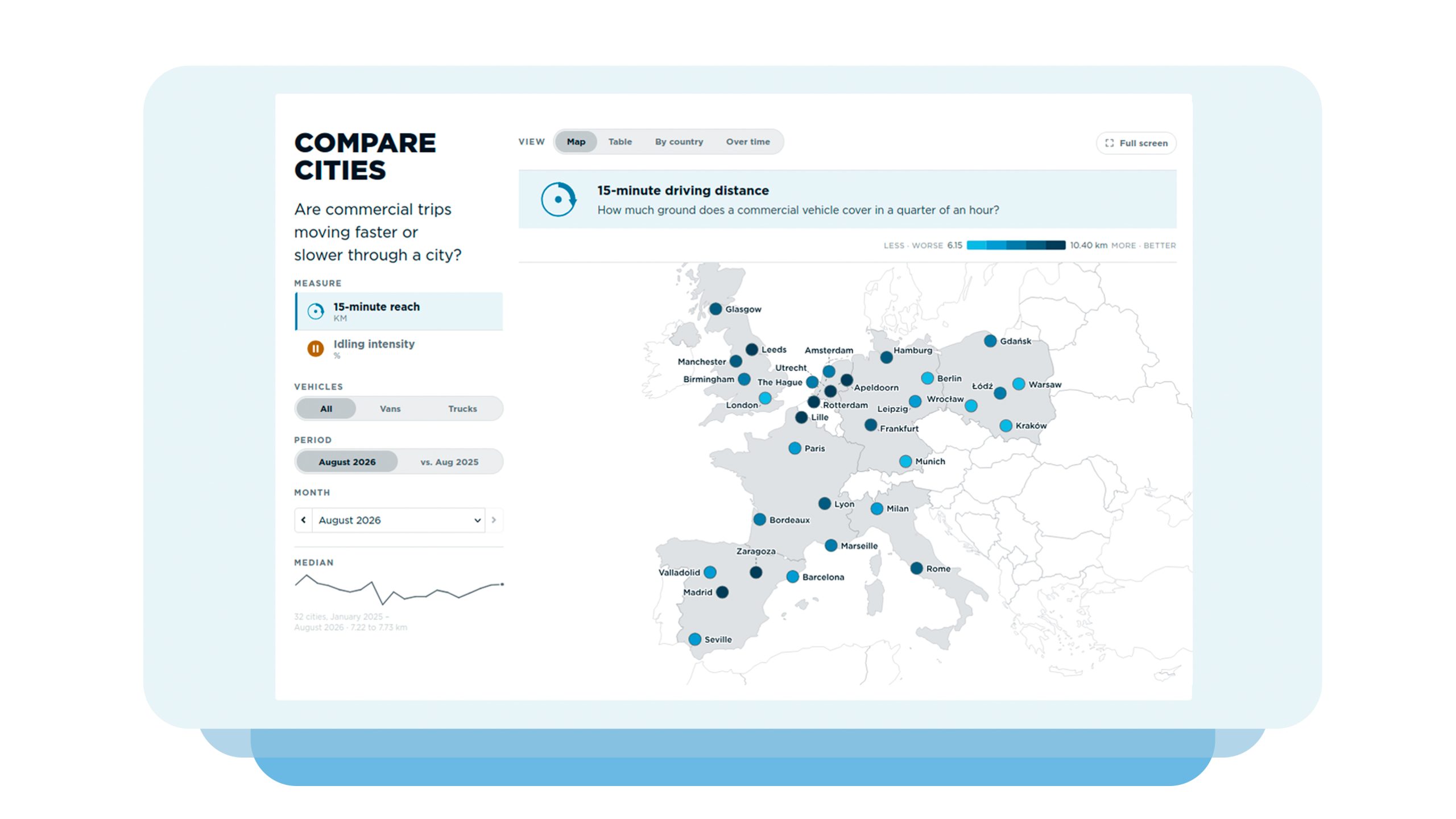
Users can rank cities, compare performance, and track changes over time using two key metrics.
- ’15 Minute Reach’ measures how far a typical van or truck can travel in a fixed 15 minute period. A higher score means vehicles cover more ground in the same amount of time.
- ‘Idling Intensity’ measures how much of a typical journey is spent stationary with the engine running. A higher percentage means more journey time is spent idling.
The first 2026 findings show clear differences between cities and countries.
Based on average monthly rankings since the start of 2026, Zaragoza (Spain), Apeldoorn (The Netherlands) and Utrecht (The Netherlands), recorded the highest 15 Minute Reach scores.
Berlin (Germany), Paris (France) and Kraków (Poland) recorded the lowest average 15 minute reach rankings in 2026.
Poland was the only country where every city analysed improved year on year for 15 Minute Reach, while maintaining stable or lower idling levels across almost every comparable month.
Rome and Milan, Italy, improved year on year for 15 Minute Reach, but Milan had Europe’s highest Idling Intensity: 21% of a typical journey was spent stationary with the engine on, compared with 16% in Paris, France. Berlin, Germany, ranked last overall for average 15 Minute Reach, while fleets in Munich, Leipzig and Hamburg covered 4.4%, 4.3% and 3.3% less ground respectively in 15 minutes than during the same period in 2025.
‘The Webfleet Commercial Trip Monitor provides a clearer picture of urban mobility through the lens of fleet operations,’ said Jan-Maarten de Vries, president fleet management solutions at Bridgestone.
‘Commercial vehicles do not experience cities the way commuters and consumers do. They follow different routes, operate under different regulations, make multiple stops, and load and unload.
‘When conditions change due to congestion, roadworks, low emission zones, regulation or major events, fleet businesses often feel the impact first. Even relatively small changes can affect productivity, operating costs, fuel use and emissions.’
In addition to the two core metrics, users can explore individual cities in more detail, including trip volumes, distance driven, CO₂ emissions, fuel consumption and the local factors shaping operating conditions.
The Webfleet Commercial Trip Monitor draws on one of Europe’s largest connected vehicle ecosystems and Webfleet’s more than 25 years of experience supporting European fleet businesses to turn data into better decisions.
To ensure comparisons are meaningful, journeys are grouped into comparable route families and assessed using a fixed panel methodology designed to track changes consistently over time.
Webfleet partnered with mobility intelligence specialist Mobito to develop the methodology and process the data. The methodology combines fleet data with advanced mobility analytics to identify meaningful trends in commercial vehicle movement across European cities.
The Webfleet Commercial Trip Monitor is updated monthly, free of charge and available now at www.webfleet.com/webfleet/resources/data/commercial-trip-monitor/