
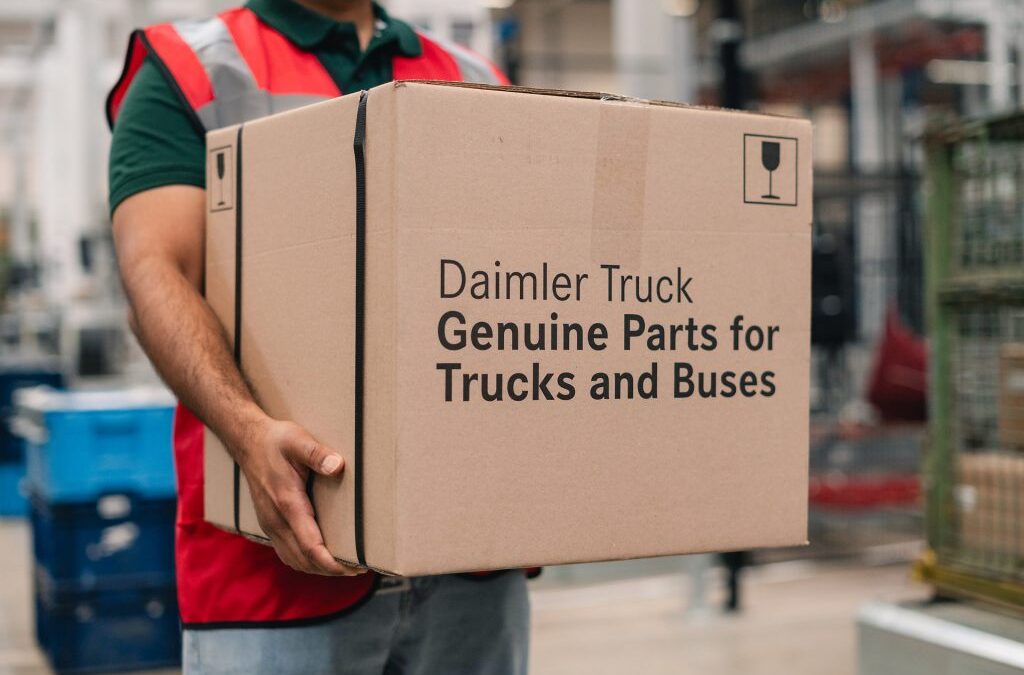
Following the opening of the Daimler Truck Global Parts Centre (GPC) in the summer of last year, the company has completed the gradual commissioning process and set the logistics centre into full operation. The priority now is to stabilise and optimise the new processes at the site.
The logistics centre in Halberstadt (Saxony-Anhalt, Germany) is the hub of the worldwide spare parts supply for Mercedes-Benz trucks. Since the end of June, the worldwide spare parts supply for the trucks has been running entirely out of Halberstadt. Parts from the GPC are shipped to 20 regional parts centres around the world, which in turn supply individual dealers across all global Mercedes-Benz truck markets.
Andreas Spreter, head of the Daimler Truck Global Parts Center Halberstadt, said: ‘The Global Parts Centre is our key to satisfied customers. They are our top priority. A reliable and fast supply of replacement parts ensures that our customers’ trucks are on the road as much as possible. Commissioning a new logistics site is something very special. New processes meet new systems and new facilities – which naturally comes with its own set of challenges.’
Andreas continued, ‘Yesterday [June 22, 2026], we transitioned the last markets and customers from the previous site in Germersheim, and we now supply the entire world exclusively from Halberstadt. This is a major milestone for us. We are currently working at full speed to stabilise and optimise the processes and systems to continuously enhance the performance of parts logistics at this site. This is how we intend to meet our customers’ expectations – true to our motto: ‘Trucks you can trust’.’
Since last summer, thousands of spare parts have been stored in various warehouse areas of the logistics centre as part of the phased commissioning process, as planned. Following the small parts warehouse, the high bay warehouse was commissioned at the end of the year. The Daimler Truck corporate logo has been mounted prominently on the exterior walls of the halls, and the public bus service has been extended to the main entrance of the GPC.
In November 2025, the first truck carrying parts left the GPC bound for Spain. Spain, France, and Italy were quickly followed by additional countries, and since mid February, the GPC has been supplying replacement parts from Halberstadt to all of Europe. Over the past few months, markets on additional continents have been added successively, including Brazil, Indonesia, and South Africa.
DP World, a globally operating logistics company, manages the day to day operations at the GPC on behalf of Daimler Truck. This includes, among other things, the execution of logistics processes in goods receiving and dispatch as well as in the parts warehouse. The company has extensive experience across the entire supply chain and maintains – despite its global structure – a clear regional focus.
Jan Lohrengel, vice president contract logistics, Central Europe, DP World, commented: ‘Successfully delivering a major project of this scale while continuously optimising the associated processes is a demanding task. The close, trust based collaboration with Daimler Truck is a key success factor in this regard. At the same time, we at DP World aim to further strengthen our role as an attractive employer in the region and welcome applications from dedicated professionals across a wide range of fields.’
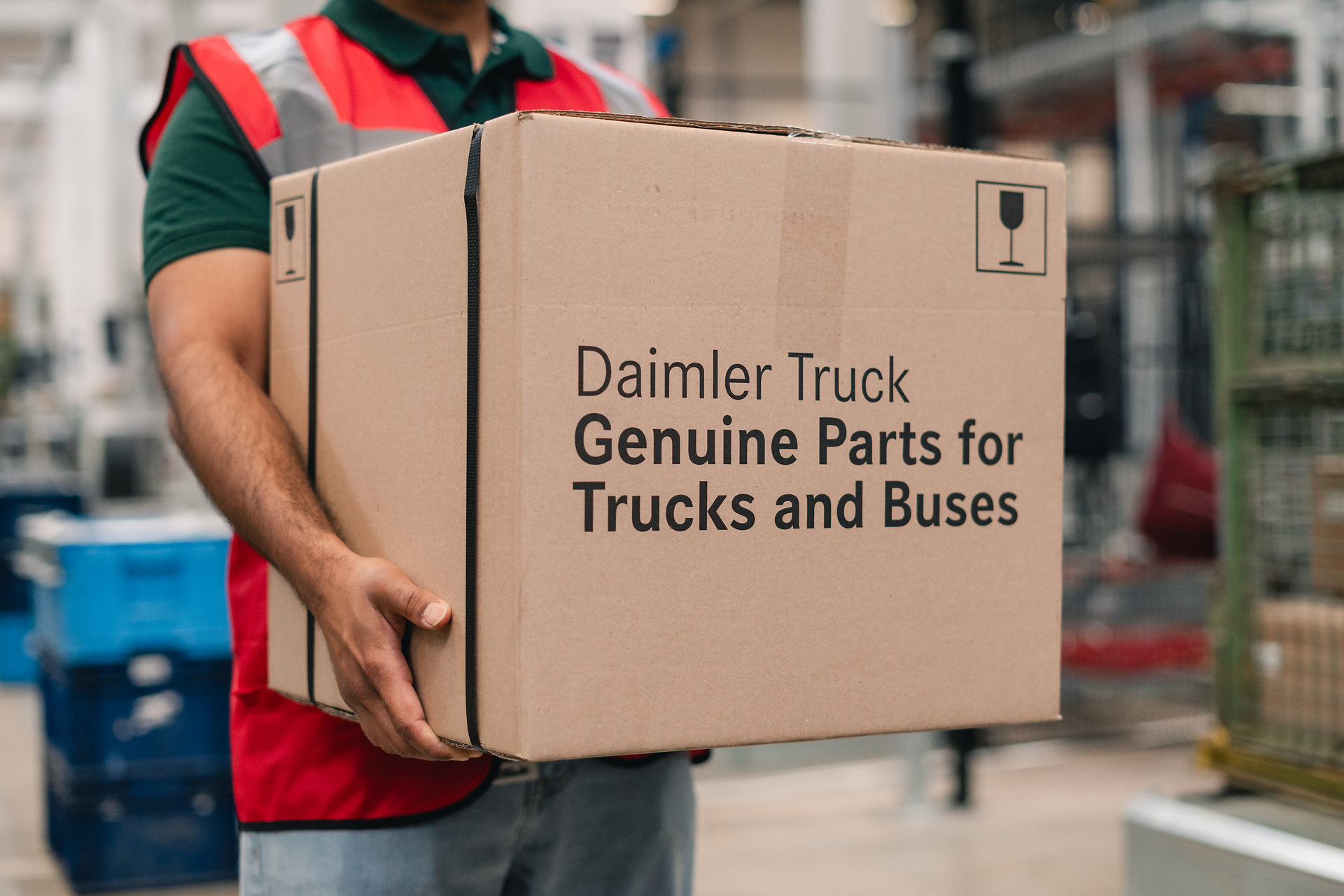
Up to 300,000 different items – from the smallest screw to the complete truck cab – are delivered from the new logistics location to vehicle dealers in over 170 countries around the world. The Global Parts Center thus plays a crucial role in ensuring international supply chains. Flexible and efficient spare parts logistics is an important success factor for Mercedes-Benz Trucks and its customers worldwide: fast and comprehensive parts supply enables vehicle fleets to maximise uptime and minimise downtime.
Around 2600 Mercedes-Benz Trucks suppliers deliver their parts to the logistics site. In accordance with the three tier aftersales logistics process, replacement parts from the GPC are distributed to a total of 20 regional parts centres worldwide. The parts centres in turn supply the dealers. Around the globe, close to 3000 dealers keep replacement parts in stock for Mercedes-Benz trucks customers.
The new building in the Halberstadt East Industrial Park will have a gross floor area of around 270,000 square metres with around 260,000 square metres of logistics space in the first phase of construction. That is more than 35 football pitches. Two large, parallel arranged halls – each approximately 200 metres wide and 600 metres long – house the inbound and outbound goods areas respectively. Additional smaller buildings are located on the premises, such as the empties and recycling halls and the office building.
Thanks to state of the art warehousing and conveyor technology, all vehicle parts are available for immediate retrieval in an automated high bay warehouse and an equally automated small parts warehouse. The high bay warehouse, with a footprint of approximately 10,000 square metres and a height of 40 metres, is directly adjacent to the hall. All parts are stored in wire mesh containers, which are automatically transported to and retrieved from the high bay racking on two levels via electric floor conveyors (EFC). In total, around 70,000 wire mesh containers can be stored in a space efficient manner in the high bay warehouse. Directly within the high bay warehouse area, a total of 21 stacker cranes take over the wire mesh containers and transport them to their respective storage positions.
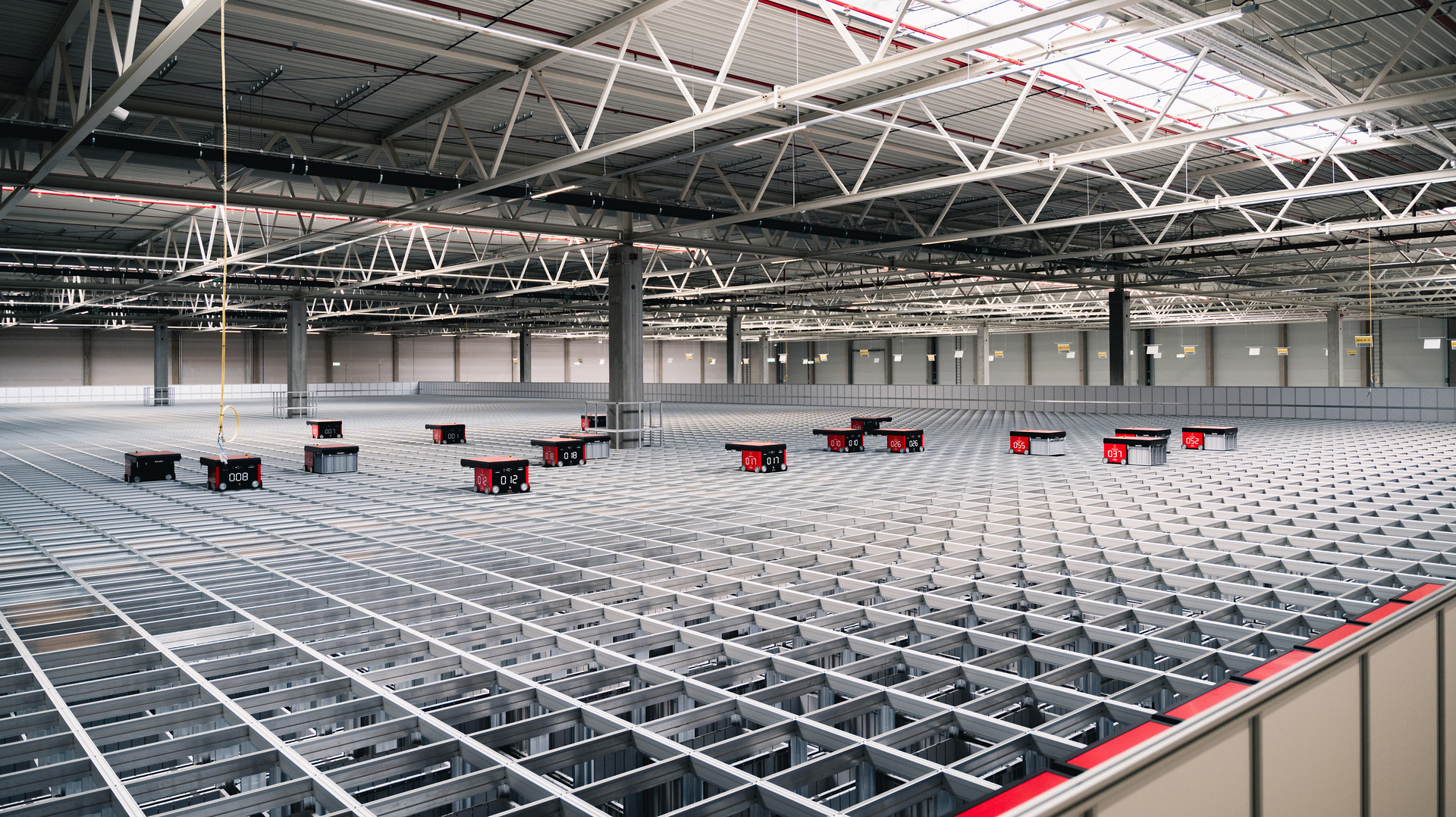
The small parts storage area is the AutoStore. In this section of the hall, a total of approximately 160,000 grey bins are arranged side by side and stacked on top of each other in a framework known as the ‘Grid’. The small parts are stored sorted within the bins. On top of the Grid, 56 robots operate in a fully automated manner, processing multiple orders simultaneously and delivering the required bins to the employees. In operation, the warehouse self-optimises, as bins containing frequently requested parts remain at the upper levels of the Grid, while bins with less frequently requested parts are positioned in the lower levels.
Throughout the entire GPC, so-called dynamic storage management is applied, which optimises warehouse space and processes. This approach does away with fixed sorting and fixed storage locations for parts. Parts to be stored are assigned to a location by the system, and the exact storage position of each replacement part is recorded in the GPC’s logistics system.
The logistics site has been designed from the outset for CO₂ neutral operation, with an energy concept that completely dispenses with fossil fuels. Neither natural gas nor oil is required. The energy required at the site is generated by one of the largest rooftop photovoltaic systems in Europe, according to the company’s knowledge. More than 90% of all roof space at the site, around 250,000 square metres, has been equipped with photovoltaic modules.
The photovoltaic system with over 22 megawatts peak (MWp) is expected to generate more than 20 million kilowatt hours (kWh) of electricity per year in the future. This is significantly more than will be consumed at the site. Surplus energy from the Global Parts Centre will be fed into the grid. Additional energy storage facilities are planned to keep the level of self-sufficiency as high as possible over the period of use. In the first stage, an energy storage facility of approximately 2000 kWh is planned, which will be supplemented by a further storage facility at a later date.
The site will be heated by electric heat pumps, which will transfer the heat into the building via underfloor heating systems. High energy efficiency will be achieved thanks to the low heating water temperatures and the storage effect of the industrial floors.
To make it easier for employees to access electric mobility, around 30 charging points for electric vehicles will be provided. The infrastructure is already being prepared for further expansion of the charging infrastructure in the future.
Appropriate charging facilities are also available for suppliers’ trucks, whose fleets will gradually be electrified: 16 charging points with 200 kW charging capacity and four charging points with 400 kW charging capacity are available for this purpose.
https://couriernews.co.uk/blog/daimler-truck-global-parts-centre-is-now-in-full-operation/